Introduction: What Is Apple Teleport?
When you hear the term “Apple Teleport,” it instantly sparks curiosity. Is it a new iPhone feature? A secret Apple innovation? Or a glimpse into the future of human mobility? In the tech world, rumors often precede revolutions, and Apple Teleport sounds like something straight out of a sci-fi movie — yet surprisingly possible given Apple’s track record of redefining what’s possible.
Apple Teleport, as the name suggests, represents an ambitious leap forward in how we think about distance, communication, and presence. While Apple has already transformed communication with the iPhone and wearable devices, the idea of teleportation — even in a digital or augmented sense — could be its most groundbreaking move yet. It could blur the lines between physical and virtual spaces, allowing people to “be” somewhere instantly without physically traveling.
Whether Apple Teleport ends up being a real physical transport technology or a next-level augmented reality experience, one thing is clear — it symbolizes Apple’s continual push to redefine how humans interact with technology. The concept may still be theoretical, but let’s explore what Apple Teleport could mean for the future of innovation, communication, and global connection.
The Evolution of Apple’s Innovation Path
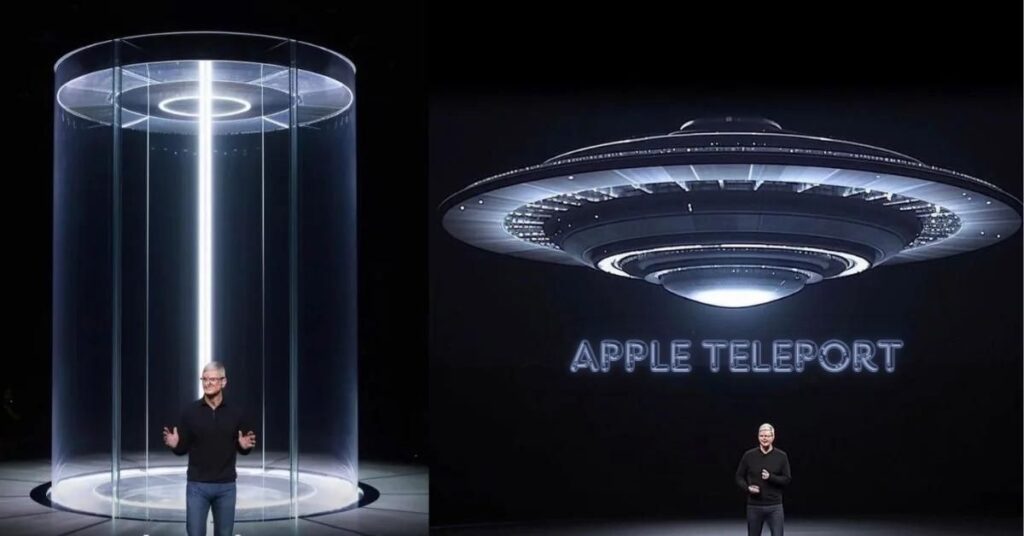
Apple Teleport has never been afraid to dream big. From the Macintosh in 1984 to the iPhone in 2007, each product has shaped industries and human behavior. With Apple Teleport, the company could once again be paving the way toward a future we can hardly imagine today.
Looking at Apple’s history, every major innovation aimed to simplify human experiences. The iPod revolutionized music, the iPhone redefined communication, and the Apple Watch turned wellness into a lifestyle. Each step took us closer to seamless integration between technology and life itself. Apple Teleport could be the next logical evolution — connecting not just devices but places, people, and emotions in ways we’ve never seen before.
In a world where virtual reality (VR) and augmented reality (AR) are growing fast, Apple’s investment in immersive technologies through the Apple Vision Pro and ARKit frameworks signals the groundwork for something much larger. Teleportation, at least in a digital sense, might not be a fantasy but a feature waiting to unfold. Imagine instantly “teleporting” to a virtual meeting room, a live concert, or even your friend’s living room through ultra-realistic AR experiences. That’s the direction Apple seems to be moving toward.
The Concept Behind Apple Teleport
At its core, Apple Teleport could refer to a platform or system that enables instant, lifelike presence in another location through advanced technology. Instead of physically moving from one place to another, Apple Teleport might use a combination of real-time 3D imaging, holographic projection, and mixed reality to create the illusion of teleportation.
Imagine putting on a sleek Apple headset — perhaps an upgraded version of the Vision Pro — and being able to project yourself into another environment with such realism that others can interact with your virtual presence. You’d see, hear, and even sense the other location in near real-time. For business meetings, remote education, healthcare, or even entertainment, this could redefine the meaning of being “there.”
Technically speaking, Apple Teleport could rely on a mix of LiDAR sensors, high-speed neural networks, spatial computing, and quantum-level data transmission. While that sounds complex, Apple is known for making the impossible simple. They could package this advanced system into a seamless user experience, where teleportation feels as natural as making a FaceTime call.
How Apple Teleport Could Transform Communication
The world has already adapted to digital communication — video calls, messaging apps, and social media dominate daily life. But even with the best video conferencing tools, there’s still something missing: the feeling of true presence. That’s where Apple Teleport could completely change the game.
Instead of flat screens, imagine interacting with someone’s holographic projection that looks and moves just like them. Apple’s precision in hardware and software integration could make such an experience smooth, realistic, and emotionally engaging. No more staring at a camera or adjusting angles — you’d feel as though the other person was physically in the room.
This kind of immersive communication could bridge distances in profound ways. Families separated by continents could share a dinner table virtually. Doctors could “teleport” into patient rooms across the globe for real-time consultations. Teachers could conduct classes with students feeling like they’re all in one shared space. Apple Teleport could eliminate the emotional distance that digital communication still struggles to close.
The Role of AI and Spatial Computing
Artificial Intelligence (AI) would likely be the backbone of Apple Teleport. Apple has already been integrating AI quietly but powerfully — from Siri’s voice recognition to advanced photo enhancements. In teleportation, AI could manage real-time motion tracking, 3D rendering, emotion detection, and voice synchronization to ensure that virtual interactions feel completely natural.
Spatial computing, on the other hand, would handle the environment — mapping spaces, recognizing physical boundaries, and placing holograms or digital avatars seamlessly within real-world contexts. The combination of these two technologies could allow Apple Teleport to create environments that respond to movement, lighting, and even emotional cues, delivering an experience that feels truly human.
For example, if you teleport into a business meeting, the system could automatically adjust lighting and sound based on your virtual presence. Or, during a family gathering, Apple Teleport might capture and transmit subtle expressions and gestures that help convey emotion more authentically than any webcam ever could.
Potential Applications of Apple Teleport
The practical uses of Apple Teleport are nearly limitless. Beyond social interaction, it could reshape industries like education, business, healthcare, and entertainment.
Education:
Imagine students being able to “teleport” into a virtual history museum or attend a lecture given by an expert halfway across the world. Learning could become a truly immersive experience, blending real and virtual spaces into one seamless classroom.
Business:
Remote work would be revolutionized. Instead of flat video calls, coworkers could meet in realistic virtual offices, collaborate on 3D models, or share data interactively. Apple Teleport could make remote collaboration just as effective — if not more so — than being physically present.
Healthcare:
Doctors could use teleportation to consult with patients globally or even guide surgeries remotely with precision. Patients who can’t travel could still receive top-tier medical care through immersive telepresence technology.
Entertainment:
Concerts, sports, and movies could evolve into shared teleportation experiences. You could virtually attend a live event as if you were in the front row, without ever leaving your home.
The Challenges Ahead
Of course, the road to Apple Teleport won’t be without obstacles. The biggest challenges would be technological feasibility, data privacy, and cost. Creating a real-time teleportation system that feels natural would require enormous processing power and extremely low-latency communication networks — likely beyond current consumer technology.
Then there’s privacy. Teleportation involves collecting and transmitting real-time 3D data about people and their environments, raising concerns about how that information is stored and protected. Apple, known for its privacy-first approach, would have to establish new standards for security and data encryption.
Lastly, affordability will be key. Advanced AR and holographic technologies are still expensive. If Apple wants Teleport to become a mainstream product, it will need to make it accessible without compromising quality — something Apple has historically done well, but it won’t be easy on this scale.
The Future Vision: A Teleporting World
If Apple successfully develops Teleport, it could mark the beginning of a new era — where “distance” becomes a concept of the past. In such a world, people could interact, learn, and work anywhere, anytime, with zero travel barriers.
Think about how much time, energy, and resources this could save. The global economy could see reduced travel costs, fewer carbon emissions, and faster communication across industries. Apple Teleport could become not just a product but a movement — redefining human connection in the digital age.
More importantly, it could change the way we perceive presence itself. Being “there” would no longer mean being physically present. The fusion of technology and human emotion could create new kinds of relationships, experiences, and possibilities that push humanity forward.
Conclusion: Apple’s Leap Into the Impossible
While Apple Teleport may still sound like a futuristic dream, so did the iPhone before it launched. Apple has a long history of turning imagination into innovation. Whether it becomes a holographic platform, a mixed-reality communication tool, or something entirely new, the idea behind Apple Teleport represents Apple’s enduring mission — to bring people closer through technology.
If history has taught us anything, it’s that when Apple dares to dream, the world listens. Apple Teleport might just be the next big step in that ongoing journey — one that could transform not just how we communicate, but how we exist together in a connected world.
YOU MAY ALSO READ
About the Author